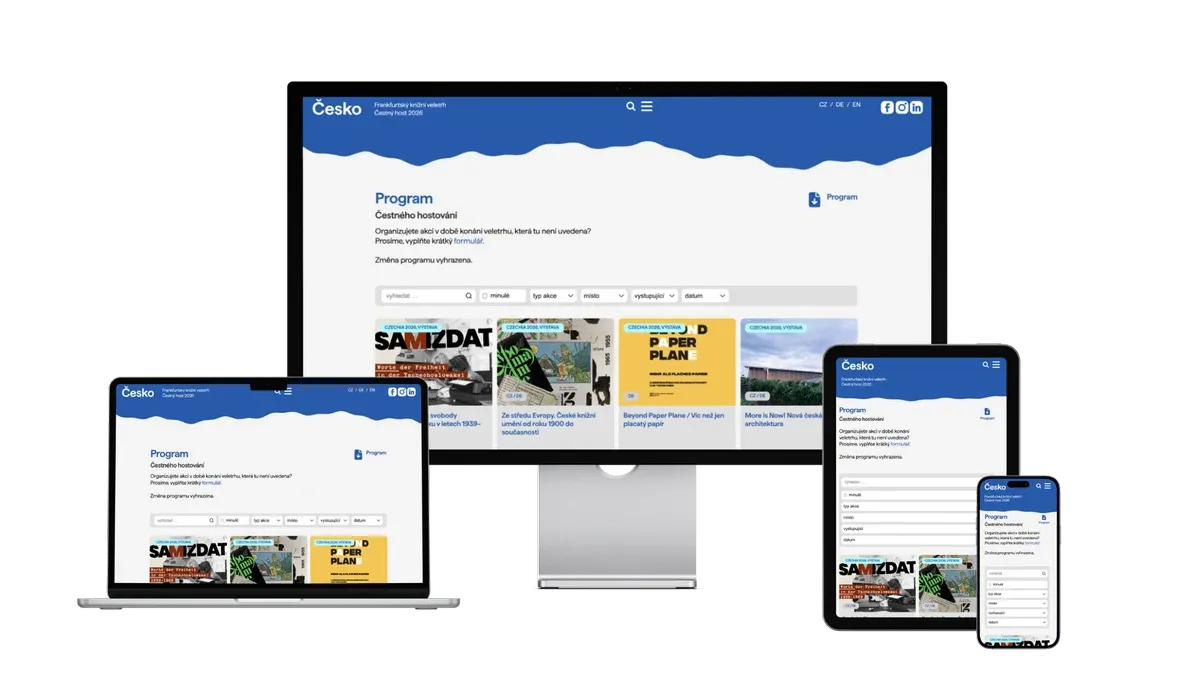
When the Czech Republic became the Guest of Honour (Czechia2026) at the Frankfurt Book Fair 2026, the Moravian Library needed a website that would present Czech literature to an international audience in a proper way.
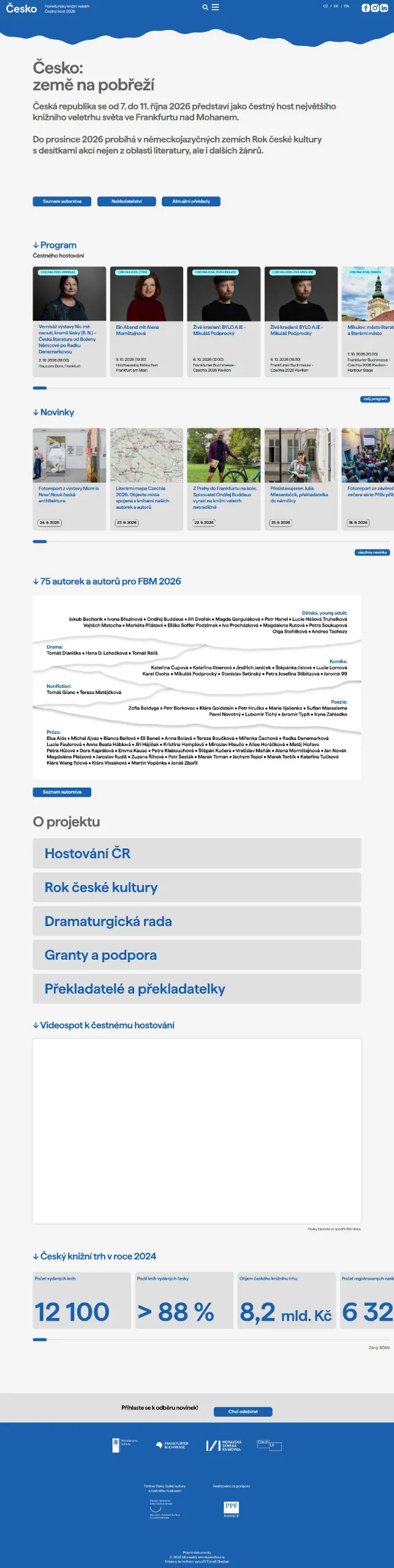
The result is a large presentation platform with advanced filters and search, three language versions and hundreds of events split into three programme parts. The website connects the technical solution with the visual identity of the project - including the typical animated wave that comes with the navigation.
The brief
The website is the main source of information for book professionals, media and the general public from all over the world.
Key requirements of the project:
- Present the authors invited to the fair, their books translated into German, and the translators.
- A full event calendar split into three programme parts: Year of Czech Culture (before the fair), Frankfurt 2026 (main programme) and ECHO (events after the fair).
- Three full language versions (Czech, German, English).
- Advanced filters and search in all sections.
- Launching the website step by step, in several phases, as the content was ready.
- Modern design with the typical animated wave from the project's visual identity.
The web design was created by the design studio Bušek+Dienstbier. My job was the technical part - turning the design into a working web application. I focused on speed, usability and easy content management for several editors.
The solution
Organising content with Custom Post Types
The project needed a clear structure for different types of content with links between them. For each category, I created a custom post type with many fields (ACF), so it is easy to fill in the content.
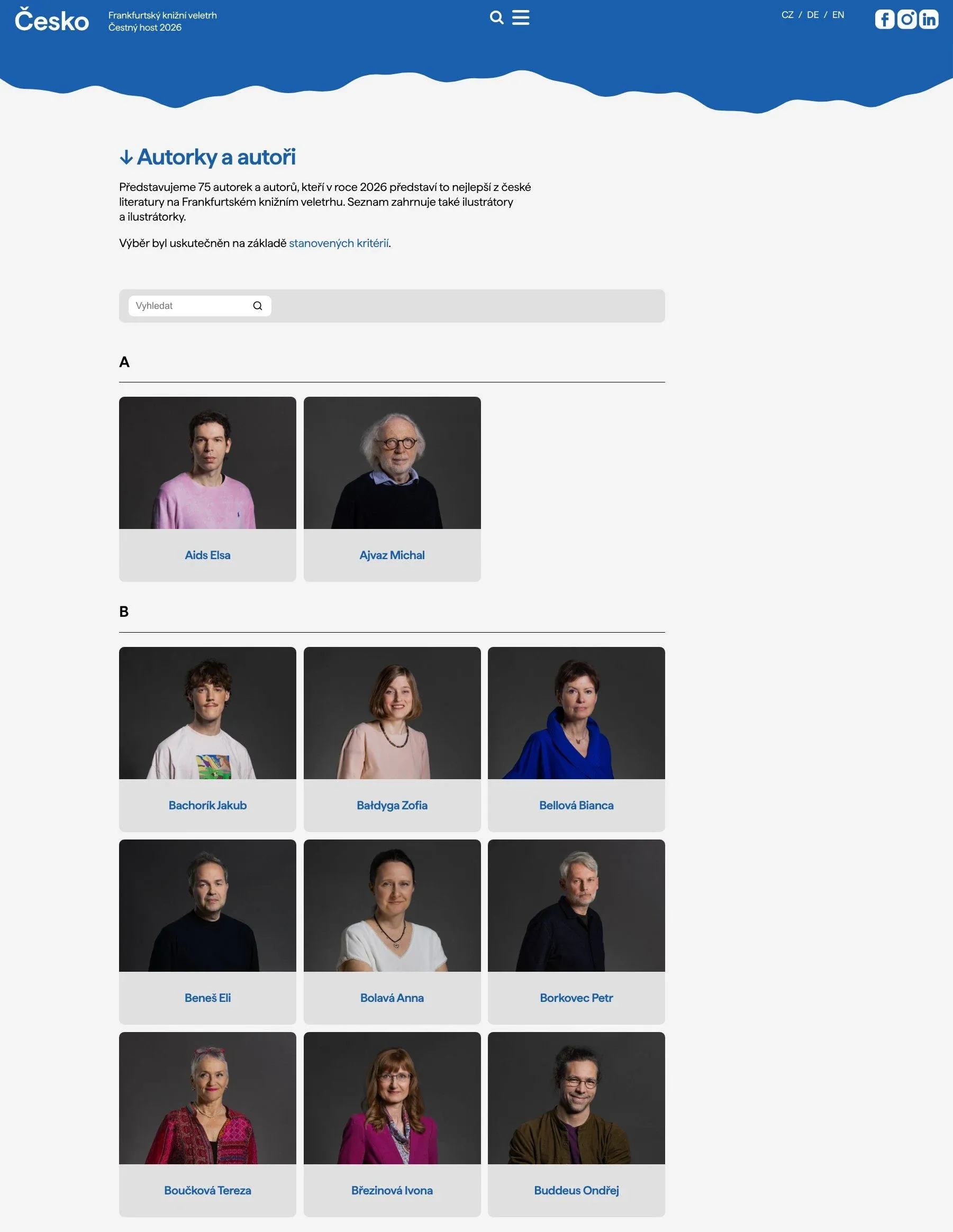
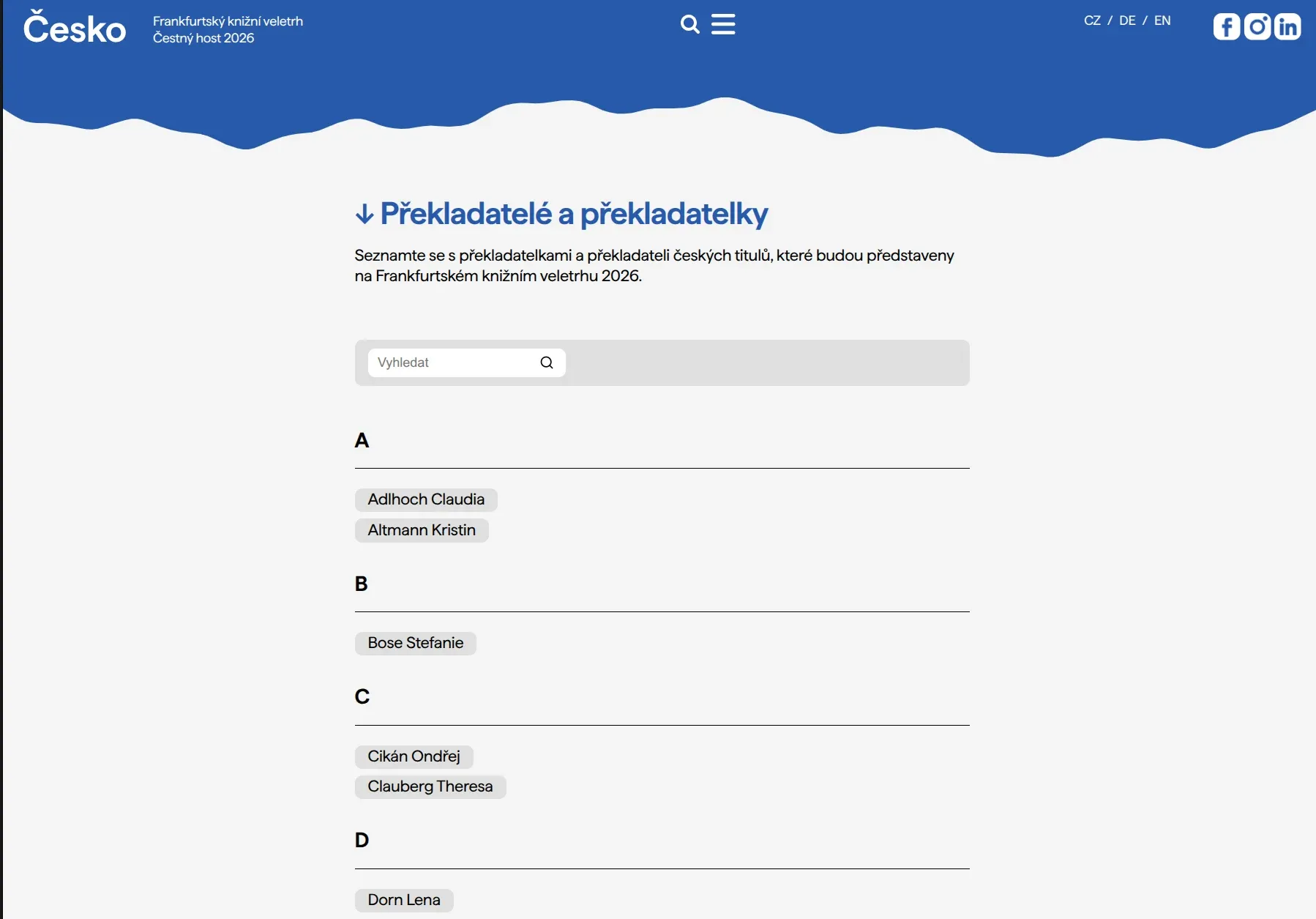
Authors and Translators - profiles with bios, photos and lists of works. Each profile shows the events where the person will appear (linked to the programme page).
Both pages have a text search.


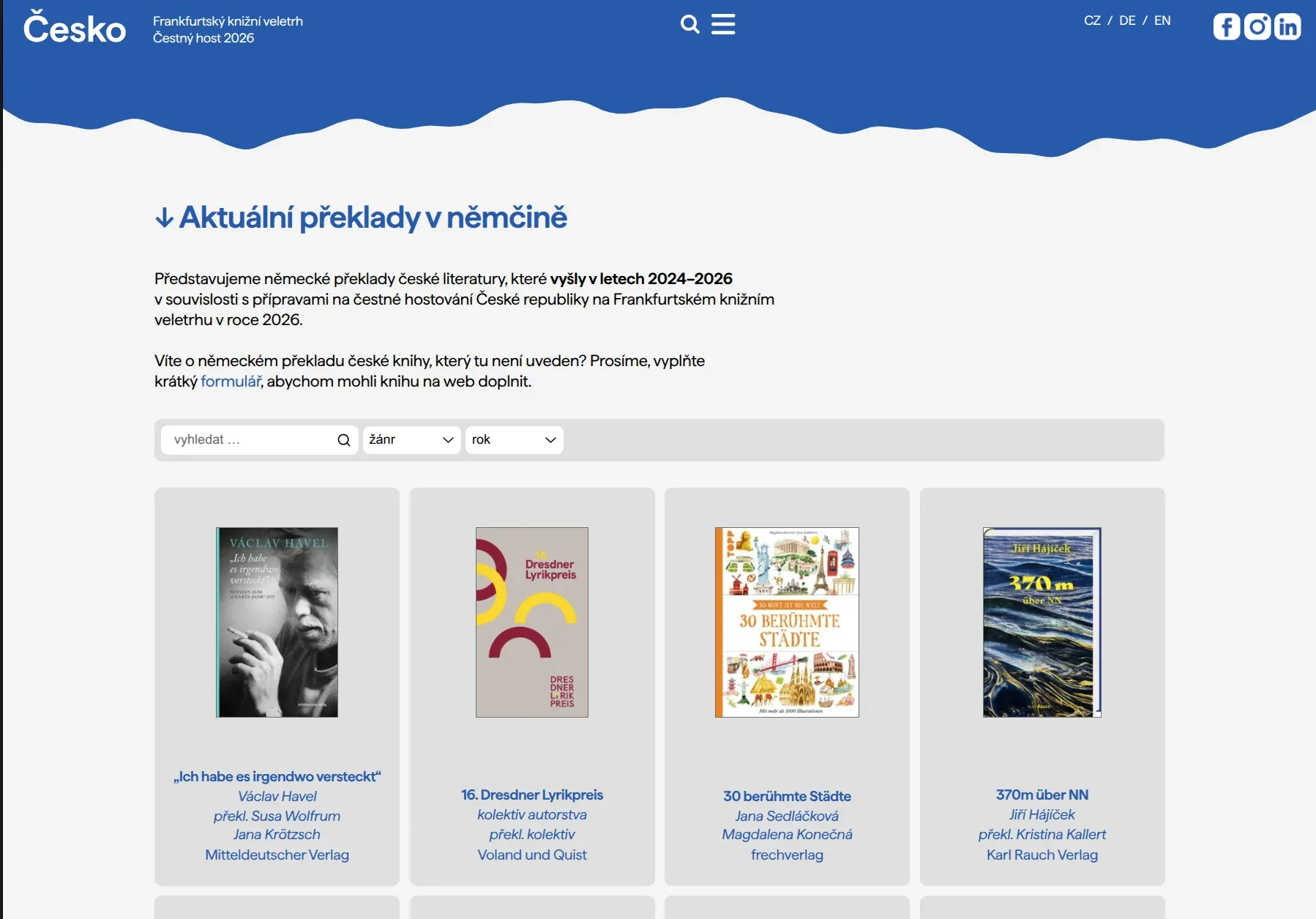
Current book translations into German - a database of books translated into German in 2024–2026. Each book has information about the author, the translator, and the Czech and foreign publisher, including links to their online shops.
You can filter the books by year of publication, genre and text search.
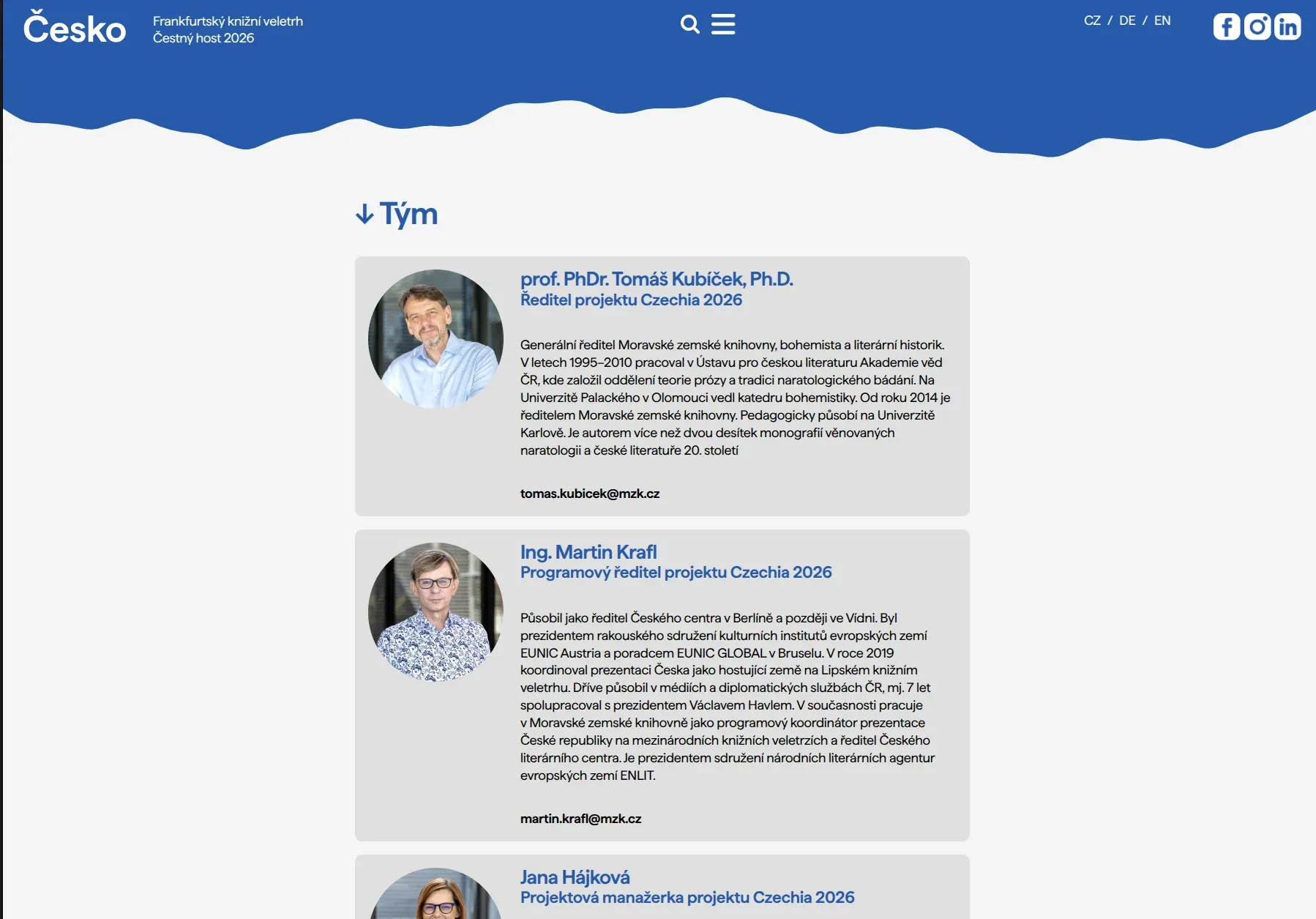
Programme Board and Team - members of the programme board and the organising team. A simpler structure with a photo, a short bio and contacts.
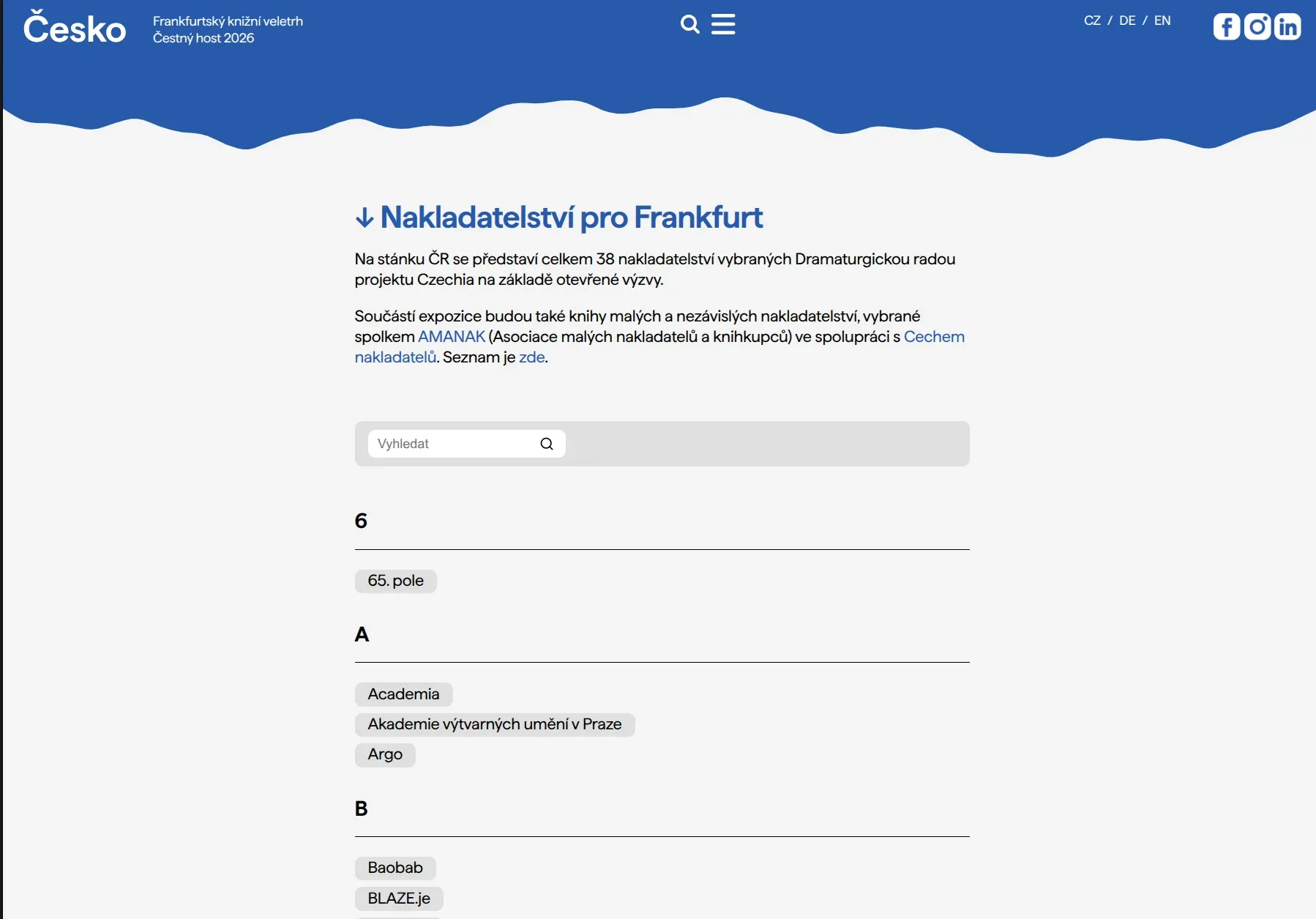
Publishers for Frankfurt as an alphabetical index with search.
All language versions have synchronised content. Editors can still make small local changes for each target audience.
The menu also has a full-text search across the whole website.


Advanced programme filter system
Programme - the most complex page, with many ACF fields. Each event has a date and time, event type (reading, theatre, exhibition, concert, debate, lecture, festival and more), venue, performing authors (linked to their profiles) and external guests (a text field, separated by semicolons). Each event also creates a link for adding it to Google Calendar.
The event programme was the biggest technical challenge. Hundreds of events in three time periods (Year of Czech Culture, Frankfurt 2026, ECHO) needed a simple way for people to find their way.
I built an AJAX filter system with four filters that work at the same time:
- Event type - a dropdown (select) where you can choose reading, theatre, exhibition, concert, debate, lecture, festival and more.
- Performers - an automatically created list of all authors from the database and all external guests, in alphabetical order and cached (it updates when events in the programme are published or changed).
- Date - a mix of select boxes and a Flatpickr calendar for choosing an exact date range.
- Location - filter by venue. The project editors add the venues themselves.
On top of these filters, there is an "upcoming only" checkbox that hides past events automatically. All filters work together - for example, a user can find all readings with a specific author in Berlin in a certain period.
The technical solution uses:
AJAX loading - when you change any filter, the list of events updates right away, without reloading the page. The request sends all active filters and returns only matching results.
- URL tracking - the filter settings are saved in URL parameters. Users can share a link to a specific filtered list. When the page loads, the filters are set automatically from the URL.
- Smart pagination - all active filters stay on when you move between pages. Pagination links include the filter parameters, so users do not lose their settings.
- Search and filters do not mix - when you use search, the filters reset, and the other way round. This avoids confusing combinations.
- I also added a simpler version of this filter system to the Authors, Translators and Current Translations pages - always with AJAX loading and saved user settings.
Animated wave in the menu
The visual identity of Czechia2026 uses a wave motif - a reference to the project's slogan "a country by the sea". The design included an animated wave in the navigation menu. It had to run smoothly without slowing down the website.
I built a JavaScript animation where the shape of the wave is the sum of several sine waves. So the wave is not a static SVG file, but a curve generated in real time. Every time the menu opens or closes, the animation looks a little different.
Navigation and accessibility
The website menu has several levels - main items contain several levels of submenus. This needed careful work on controls and accessibility:
- Different behaviour on different devices - on desktop, a submenu opens when you hover over it (with a 300 ms delay, so it does not open by accident). On mobile, you need to tap. The website detects if the device has a touch screen.
- Keyboard navigation - full support for the up/down arrow keys to move between items, Enter to open or select, and Escape to close the menu. Correct ARIA attributes for screen readers.
- Automatic closing - the menu closes when you scroll (on desktop) or click outside the navigation, so it does not get in the way of the content.
Performance optimisation
The website uses a lot of JavaScript for animations, filters and navigation. It was very important to load it only where it is needed.
I built the website on WordPress with Oxygen Builder (a visual page builder). To make adding content quick and easy, I prepared many custom post types with fields in the admin area. The editors only fill in the content, and the website shows it automatically.
Polylang handles the languages. It creates a separate version of each post type. The language versions are Czech, German and English.
Events are exported to Google Calendar through a special link format. No library is needed - only a correctly built URL with the event parameters.
The result
The Czechia 2026 website was launched step by step, in several phases:
- February 2025 - version zero: one static page with information about the project.
- May 2025 - first phase with static pages.
- June 2025 - launch of the dynamic parts: the event programme with advanced filters, the database of authors and translators, and current translations. AJAX filters fully working in all sections.
- July 2025 - all three language versions finished, translations fine-tuned and final performance optimisation.
Two weeks before the Guest of Honour presentation (23 September 2026), the website contains:
- Almost 400 events (x3 languages).
- 75 author profiles (x3 languages).
- 34 translators (x3 languages).
- Almost 250 news articles (x3 languages).
- 192 books translated into German.
- 38 publishers.
- 20 grants and funding options.
- 100 partners.
The Moravian Library now has a modern presentation platform that represents Czech literature well on the international stage. Editors add new content through a simple WordPress interface with ACF fields. Visitors find their way easily thanks to advanced filters and search.
The website runs on my own VPS. There, I block attacks on the website, and I add more computing power as traffic grows.
Do you need a website for a cultural institution or an international project?
If you are looking for a website with advanced filters, well-structured content or custom features beyond standard templates, I will be happy to help you build it.
Contact me and let's talk about your project.